
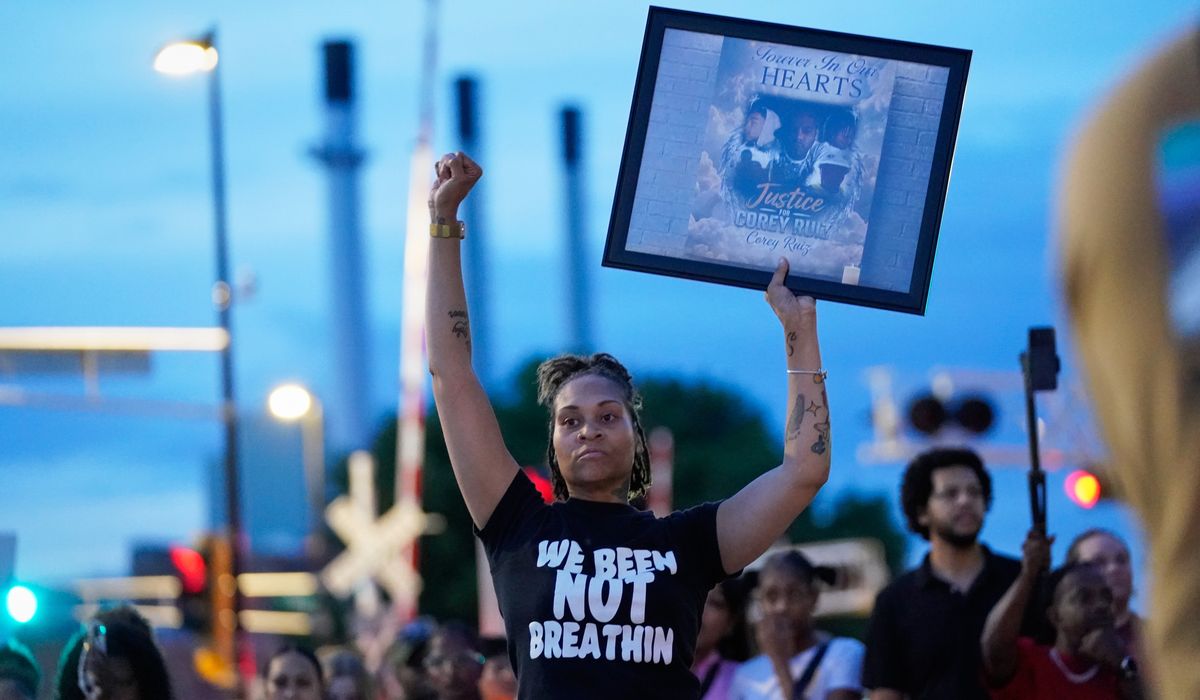
The mayor of Madison, Wisconsin, called for protesters to disband from an “autonomous zone” established at the site where police shot and killed a knife-wielding homeless man last month.
Mayor Satya Rhodes-Conway said the city is preparing to tow vehicles that activists have used to block an intersection in the Marquette neighborhood to protest the police killing of 38-year-old Corey Durell Ruiz.
Authorities said officers shot and killed Ruiz, an ex-felon, while he was resisting arrest on July 22 in the state’s capital city. Madison Police Chief John Patterson said Ruiz pulled out a knife during the altercation and wounded an officer before police fired the fatal shots.
State investigators are reviewing what led up to Ruiz’s killing, but many residents in the deep blue city determined the killing was unjust shortly after it became public knowledge.
Protesters harangued police and public officials at press conferences about the incident while holding up signs saying “Corrupt cops deserve to die too.”
Last week, demonstrators ramped up their protest campaign by positioning their cars and other objects to barricade themselves inside the “Corey Ruiz Autonomous Zone” where he was killed.
The area, which is modeled after Seattle’s “Capitol Hill Autonomous Zone” during the Black Lives Matter protests of 2020, calls itself a “law-enforcement-free zone” that has become a gathering place for both activists and the city’s homeless population.
“There are too many residents and local businesses suffering because of the occupation, and it’s become increasingly clear that unsheltered people are being used as leverage for demands that, frankly, the City of Madison cannot deliver because we do not have the power to deliver them,” Ms. Rhodes-Conway said in a statement Monday.
She alluded to requests for the city to bring criminal charges against the officers involved in the shooting of Ruiz, even as the Wisconsin Department of Justice handles the probe into his death.
“I’m increasingly alarmed that those supporting the occupation at the intersection of Williamson Street and Baldwin Street are either purposefully ignoring the harm being done, or deliberately hoping that the situation spirals further out of control,” she said.
Ms. Rhodes-Conway said tow notices were placed on vehicles forming a perimeter around the protest area, and impoundments will soon follow.
She also rebutted social media chatter that city officials were offering porta-potties, dumpsters and other handouts to keep the autonomous zone up and running, and threatened fines against the company that supplied the porta-potties.
Council member Tag Evers called the autonomous zone “revolutionary cosplay” in his own statement discussing the potential dangers of letting the encampment persist.
He referenced how Seattle’s autonomous zone six years ago soon became the scene of several shootings and two killings in the 23 days it was allowed to operate.
While Madison’s encampment has not seen any deadly violence, Mr. Evers noted that the autonomous zone is affecting response times for emergency vehicles.
“This is not hyperbole. This is reality,” Mr. Evers wrote. “Those who are using the encampment as a bargaining chip to pressure the city to action, those who are threatening escalation if demands are not met, are putting other lives at risk.”
Ruiz’s death has become an issue in Wisconsin’s governor’s race, with leading Democratic hopeful and democratic socialist Francesca Hong calling Ruiz’s death an “execution.”
Ruiz has garnered an outpouring of sympathy despite his violent past.
Court records show Ruiz has spent time in jail for felony convictions for robbery, strangulation, resisting an officer and causing bodily harm, on top of misdemeanor arrests for car theft, battery and disorderly conduct.
Ruiz has nine arrests and eight convictions just for resisting, obstructing, threatening or injuring police officers. Five of those cases happened with Madison police.
