
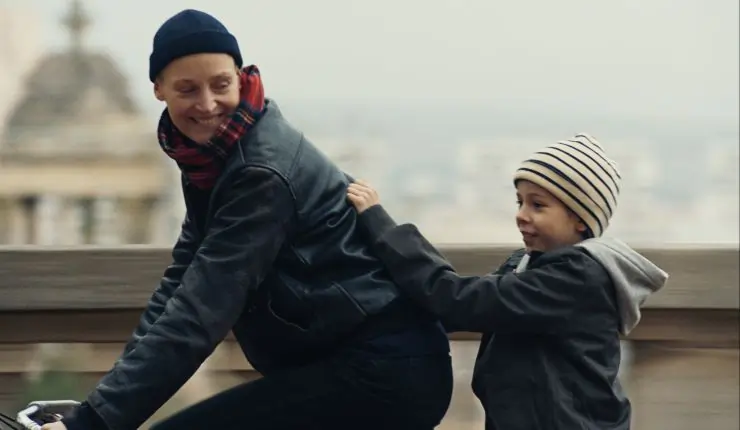
Vicky Krieps is at the top of her angular game in the moving and multifaceted queer drama Love Me Tender. The Phantom Thread star has consistently made a virtue of characters that flirt with both sympathy and difficulty, from Corsage to the Viggo Mortensen Western The Dead Don’t Hurt, and writer-director Anna Cazenave Cambet, adapting Constance Debré’s novel, plays to the actor’s strengths in this tale of one woman at a pivotal crossroads in her life.
Krieps plays Clémence, a Parisian woman who has long been separated, albeit on somewhat amicable terms, from her ex-partner Laurent (Antoine Reinartz). Clémence shares custody of their young son Paul and, as a counterpoint to the domestic scene, enjoys a somewhat hedonistic, bohemian lifestyle by night, engaging in casual hook-ups. She has also left her former job as a lawyer to pursue her dream of becoming a writer.
Cambet uses Clémence as a fascinating cross-section of an emotionally divided personality. Clémence admits that, for a long time, she had known that her marriage was a sham, barely patched together out of sincere love for her son. The intersection of hedonism and parental responsibility rears its head slowly and subtly through Cambet’s measured script and direction: Paul is becoming acutely sensitive to his mother’s absences, aggravated by her impulsive desire to reclaim the authenticity that was subsumed by her marriage to Laurent. When she is unable to raise Paul from bed one morning to spend the day with him, Clémence is utterly defeated, and it augurs emotional turbulence to come.
When Laurent decides to fight Clémence for full custody of their son, the Parisian bourgeois illusion is thoroughly shattered: he is seemingly enraged by his ex-wife’s queer liberation (has he always known and been in denial, or is it fresh news to him? Pleasingly, the movie doesn’t answer this outright), and the narrative takes a far more complex turn. It goes beyond the battle for maternal rights, instead actively turning over the notion of queer rights in a world that is yet to fully catch up. In fact, as far as Laurent is concerned, the world seems actively regressive and hostile, although the film never soapboxes nor lets its central figure wholly off the hook.
The script is pleasingly forthright as to Clémence’s self-destructive selfishness. She wants the best for her son but is unable to reconcile it with her own needs, and Krieps actively challenges our sympathies with a tangy and plausible performance that refuses to sugarcoat emotional realities. Krieps expertly utilises her physical presence, whether it’s gyrating in a queer club or refusal to maintain eye contact during tough conversations, to palpably visceral effect. Similarly, her scenes with Paul’s actor Viggo Ferreira-Redier radiate both parental intimacy and a melancholic sense that things may be about to shatter permanently.
The effects of the ongoing custody battle radiate outwards in the manner of an emotional atom bomb. Clémence’s putative relationship with Sarah (Monia Chokri) suggests a kind of stability, but it may not be enough to survive both a sense of innate impetuousness and the responsibility of motherhood. Cambet keeps all of these character-driven plates spinning nimbly, but always circling back to our infuriating yet sympathetic central character.
Equally important is the depiction of Paris itself, a teeming and grounded intersection of messy lives, open-ended boulevards and graffiti-marked avenues that has little time for tiresome tourist eye views of the Eiffel Tower and other landmarks. As with Krieps herself, it feels all-too-real, a city of tough love and pragmatic realities where tenderness of any kind is both fleeting and hard-fought, but all the more palpable for that.
In cinemas on August 7th / Vicky Krieps, Antoine Reinartz, Viggo Ferreira-Redier, Monia Chokri / Dir: Anna Cazenave Cambet / Peccadillo Pictures / 15
Discover more from
Subscribe to get the latest posts sent to your email.

