
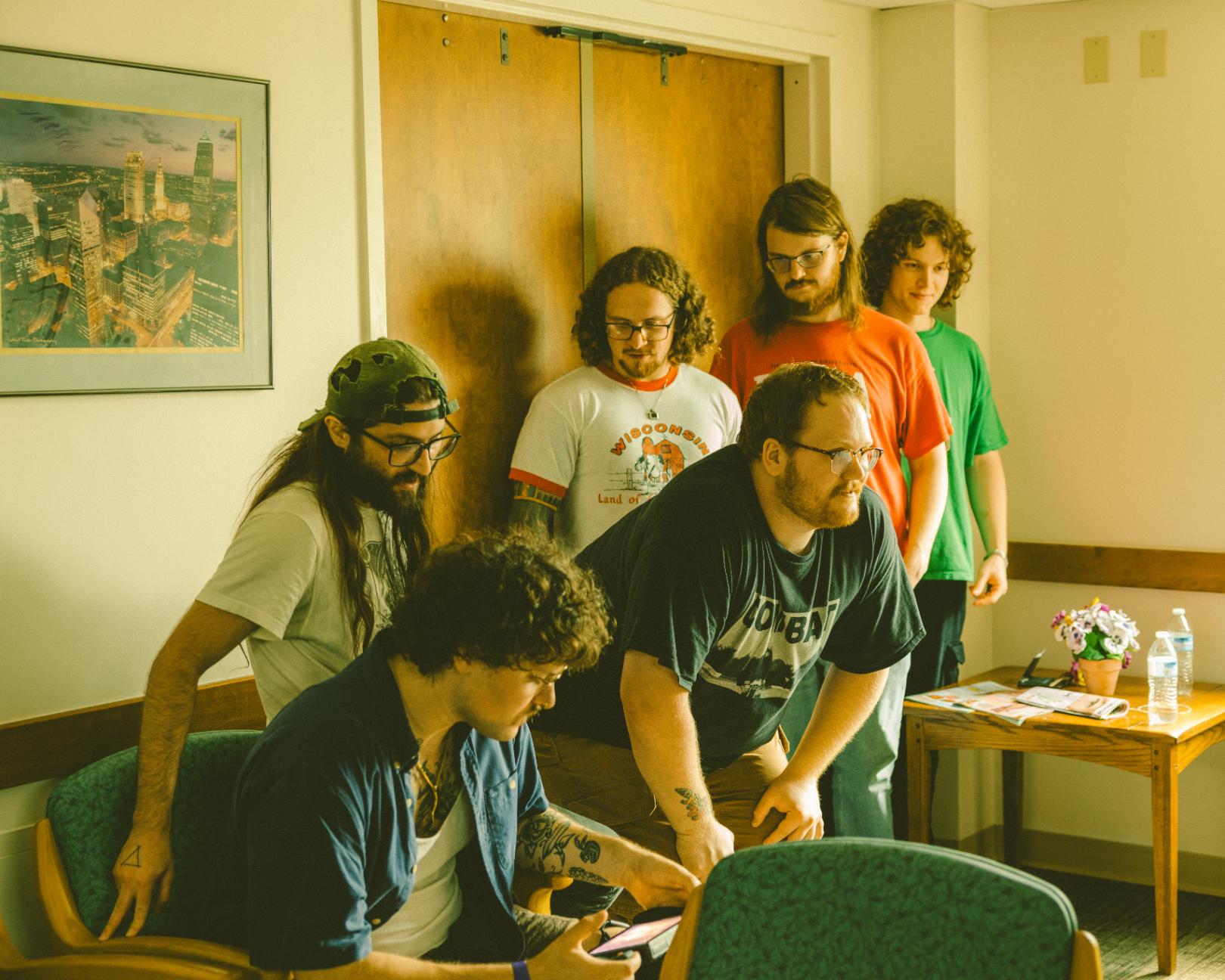
For Harrison Gordon, bliss isn’t the same thing as happiness. That gap is the whole concept behind their new album, BLISS, which grew out of a period of chasing short-term dopamine hits: video games, TikTok, a revolving door of screens designed to help him avoid sitting with his own thoughts.
BLISS is the next chapter in a project that’s evolved a long way from when it started. Six years ago, Gordon was a kid in Illinois writing songs alone in his bedroom, uploading them to Spotify with no real audience in mind. That EP, 2020’s You Might Feel Lucky Now, was the first step toward something that would eventually become a full band. Three years later, he released The Yuppies are Winning, a record that was the catalyst for the rest of the band forming.
Read more: Fan poll: 5 best Chicago bands
“That was the first time I was like, ‘I’m just gonna make this one record that sounds like the bands that I really, really like,’” he says from his apartment in Chicago. “I assumed there would be 10 people who are really gonna like it, and everyone else is either gonna ignore it or listen to it one time and tell me they thought it was really good, and that’ll be enough.” The Yuppies, which was still largely a solo effort, all built on a laptop, helped him find the sound he wanted to make and bandmates to tour with. “[Being a solo artist] was never really my goal,” he admits. “I always wanted to be in a band.”
Now, with BLISS, Gordon and his bandmates have made their most collaborative record yet, built not in isolation but in a cramped practice space, night after night. It’s a record shaped by microdosing distractions in any form possible to avoid looking in the mirror in front of you, a theme they explore on their recent single “Like Me Less.”
Dillon Anderson
It’s been six years since You Might Feel Lucky Now. Tracing that arc through The Yuppies Are Winning to BLISS, how do you see yourself growing as a songwriter?
The interesting thing about this project is that when you go back on Spotify, you can find the first songs that I ever wrote. That was just me in my room. The Yuppies Are Winning was all me, just made on a laptop. We wanted to tour that record, and we were playing things live a little bit differently, which made us decide, “Let’s just do this as a band and not as a solo thing.” The Yuppies Are Winning was when I started making and writing the exact songs I wanted to hear and liked.
This must have been a real shift from your last record, working with other people in the room. Were those proper writing sessions, and did letting others in make the process feel more exposed?
Definitely, I was so used to finishing a song and then bringing it to people. There was a four-month period where we practiced every week, and every week I came in with a new song, and we would basically play that one song the whole time and get it to a place that felt cool. We didn’t have any microphones because we couldn’t figure out how to get the PA in our practice space to work, so I would just scream over the drums. That’s how I worked out lyrics. I knew nobody was really hearing me, and it was the one time I had when I could be as loud as I wanted and still be silent. That helped a lot with the writing of the record because I could come up with all this stuff, and then I would take what we had home, plug it all into the laptop, and then I’d have the thing in front of me.
The lyric “bliss is good as I can get” is kind of the ethos behind the album. How did landing on that idea change the way you approached writing compared to past projects?
There’s a really funny answer to that, which is that I thought of the name first. I had the album name before I had the songs. I was like, “Well, I want to riff on that idea a little bit.” The angle I landed on was this idea of happiness and pleasure being completely disconnected from each other. There’s this eternal pursuit of happiness, but you don’t necessarily need to play that game because there’s so much short-term dopamine waiting for you in the world. A lot of the time, you can get caught up in that and then realize after a while that you haven’t really participated in the game everyone else seems to be playing. For me, that came from sitting around playing games on my PlayStation, listening to music, watching YouTube videos, having two screens constantly running, just trying to avoid having a thought.
I catch myself doing that all the time. I’ll be watching something and then open TikTok on my phone and think, “Why am I doing this?”
Exactly. I’m drinking a Diet Coke, I’ve got a vape or a Zyn, I’m texting someone back between games, and I’m like, “Yes, this is the best feeling in the world.” I did that for eight months straight, and then I was like, “Something needs to change right now.” That’s around the period when we wrote the record. A lot of it was me wanting to write about something that felt really uninspiring, because there are plenty of emo and rock songs about wasting time, but a lot of them are about wanting to waste time with someone else. I was interested in writing about what it feels like when you come out the other side of what professionals would call a depressive episode, and you’re suddenly like, “Whoa, what was that?”
I would go through these periods where I knew that the idea of feeling long-term happiness or fulfillment was probably beyond me, at least for the time being. It became this complacent feeling of, “Well, I can settle for as much stimulus as possible until that stops working, and then I’ll find something else.”
You were asking for book recs on Reddit, and I remember you framing it as, “Time to be an adult and read books.” How’s that transition been, going from something like TikTok or gaming to a more tangible medium?
That idea has come from me starting to write our next record. I’m kind of an obsessive freak, and music and songwriting are basically all I think about, so I tend to think about enjoying other things in terms of how they affect my creative process. Originally, this year I started watching a ton of movies. I finally reached the age where I have the attention span to watch a full movie. I was like, “I’m gonna watch movies now, and that’s gonna be my source of inspiration instead of just playing video games and scrolling TikTok.” That worked for a while, although it’s not really that much better in some ways.
Then I was like, “I’m gonna start reading, because then I’m absorbing words and getting better at my linguistic skills,” and that actually has made a tangible difference. I like reading about real people because I find people talking about themselves fascinating, which is funny because that’s basically what I attempt to do for a living.
In “Like Me Less,” the lyrics “No one knows me, I barely know me/And that’s the way it oughta be” and “No one hurts me like I hurt me” really got to me — beautiful, but sad too. Can you walk me through writing that one? I think everyone can see themselves in that idea of being your own worst enemy.
That’s one of my favorite songs I’ve written. I did that thing where you start to write about one thing, and then you write a bunch of non-sequitur lines. I think it has to do mainly with insecurity, and then trying to dig deeper. You’re like, “I need to do some personal work. I need to dig deeper into what makes me feel like this.” Then you start doing that, and you realize that you don’t want to go down that path.
I think those lines — “No one knows me. I barely know me/That’s the way it oughta be” — are about rejecting that kind of personal work altogether. It’s like accepting, “That’s just how it is. Whatever, fuck it.” It’s talking about resigning yourself back into whatever habits you have because you understand that personal work is hard.
When you think back to being a kid, what were some stories that really stuck out to you that made you want to go into this world of storytelling?
I’m definitely a product of my time — comic books as a kid, and Sam Raimi’s Spider-Man movies. In middle school, it was Scott Pilgrim, Dragon Ball, and video games. I’m from Illinois, so everyone here is super obsessed with John Hughes movies, and those were big growing up. My parents would only let me watch movies that they watched when they came out in the ’80s. That is still some of my favorite stuff. When I was 19, I put out a whole EP about Animal House, because that was one of the biggest things I had.
I didn’t engage with media in a meaningful way, outside of running over people in Grand Theft Auto, which I did a lot of as a kid. But a lot of it was engaging with media as a tool for connecting with other people. That was the big thing for me. Comic books, because everyone knew about Batman, and playing multiplayer video games with the neighborhood kids — that was a big part of it.
It wasn’t really until my late teens that I started watching and reading stuff that felt more impactful to me, where narrative and storytelling took on more importance. The place where I engaged with that stuff on the most meaningful level was always songwriting. As a kid, it was the only thing I wanted to do and wanted to get good at doing, so that’s where I really connected with storytelling.
Chris Malchow
How has touring and leaving Illinois influenced your recording process? I imagine playing songs live for people changes your relationship with them — how much does that feed back into the studio?
One of the greatest things about the music world is that we get young musicians and put them on sabbatical for five years to just go explore the world and keep writing — it’s part of the job. Writing’s gotten dramatically easier since we started doing that, because there’s so much to pull from. We got to play this record in front of a ton of people before we put anything out, which isn’t something a lot of bands get to do. We did a headline tour and played all but one song from this new album before it came out. I’d change lyrics night by night, or realize a part we thought would be cool actually shouldn’t change. All of that shaped how the songs developed, because we wanted everything to feel fully lived-in by the time people heard it.
Yeah, it’s like muscle memory almost at that point.
We’re really critical of ourselves — not in a “everyone should feel bad for us” way, but we work really hard to sound good because we have to. Some bands don’t rehearse much — they learn stuff on their own, meet up for six hours before a tour, run their 90-minute setlist, and it sounds amazing. We have to practice every single week just to sound OK. I’ve made peace with that.
By the time we got to the studio, it was more about recreating what we already had, rather than starting with loose ideas and pulling them together, which is how a lot of bands work in the studio. We came in with everything we wanted already figured out, so it became about getting really precise with the details.
There were a couple songs where we thought, “Maybe when we release this, people will move more.” That was the case with “Like Me Less” — probably terrible promo to admit this, but we played it once on tour. It’s a slightly slower song, and since it was our first time playing it live, we played it badly, and nobody moved. We just told ourselves, “They’ll get it once it’s out.”
When you release a body of work like this, do you view it as a chapter closing or a chapter beginning?
It’s weirdly both. Behind the scenes, between me as a creative entity and the band as a creative entity, this chapter is already over. These songs are being put on maintenance — we’re getting them really dialed in, but nothing’s fundamentally changing anymore. Outside of that, I listen to the album maybe twice a week — one of those listens is overwhelmingly positive, and the other is me thinking, “Why didn’t we change this? We should have changed this.”
As a creative entity, I’m already divorced from it. I’m already writing the next thing, and that’s honestly where my real excitement lies. I’ll send a friend the album and say, “This is our new album, but here’s a demo I just made that sounds like shit — isn’t this the best?”
It’s exciting to be in the mode of, “This is our new record, hope you guys like it” while secretly already onto the next thing. It’s a balancing act — not wanting to feel like I don’t care about this record anymore because I’m excited about the next one. We’re lucky to have the time, so we basically treat it like a sports game — the game’s 90 minutes long, and you spend every second trying to score. You don’t take a break when the other team has the ball to go retreat to a cabin for a week and write. We get in there and put up shots until the buzzer rings, then put our hands up.
